Every grant dollar, where you promised it would be.
What ClearFund is, how fund accounting works, what has been built, and where it honestly stands.
Narrated walkthrough · 18 min · 8 chapters
Shelter staff wages, July$6,120.00AFF-2026-118 · p.4 §2.1Covered by this grant
Volunteer training lunch$186.4090CY7241 · p.11 §6.3Check the food rule
Bus passes for youth clients$420.00WD-27-1104 · p.7 §3.2Covered by this grant
Fund accounting in five minutes, for people who have never had to care.
Fund accounting 101
A business has one pot of money. A nonprofit has many, and each one has rules.
When a foundation gives a youth shelter $75,000 for its kitchen program, that money cannot buy a van. Accountants call the pot a fund and the rule a restriction.
01
Unrestricted
Money the organization may spend on anything in its mission. Individual donations, most earned revenue.
02
Restricted by purpose
Money given for one program, one project, or one kind of cost. Most foundation and government grants.
03
Restricted by time
Money that may only be spent inside a window. Spend it early or late and it was never allowed.
Fund accounting 101
A grant agreement is a promise written in thirty pages.
Inside are the rules that decide whether a dollar was spent correctly. The same four questions come up in almost every one.
What is allowed
Which costs the funder will pay for, and which it will not. Food, travel and equipment are the usual arguments.
When
The period of performance. A service delivered the day before the contract starts is not covered.
How much per line
A budget by category, and how far you may drift from it before asking permission.
What you owe back
Reports on a schedule, in the funder's format, with numbers that tie to your books.
Fund accounting 101
Spend enough federal money and the government sends an auditor.
Organizations that spend more than one million dollars of federal money in a year get a Single Audit. The auditor tests whether the rules were followed and files the results publicly.
A finding
The auditor's written conclusion that a rule was broken. It goes on a federal record with your name on it.
Questioned costs
Dollars the auditor thinks may have to be paid back, out of money you did not set aside.
A repeat finding
The same failure two years running. Funders read these. Boards read these. The next application asks about them.
What the public record shows
Ten years of audits, 31,040 nonprofits. The pattern is about memory, not carelessness.
15%
of audited years at small nonprofits came back with at least one finding.
1,285
organizations in the last two years failed the same way twice.
2,715
had findings in three or more separate years across the decade.
#1 and #3
Reporting, then allowable costs, are the most common categories. Both are about rules that lived in a filed document.
Source: Federal Audit Clearinghouse, public under 2 CFR 200.512. Counts are of organizations, not individual findings.
Why careful people still end up with findings, and why it is nobody's fault.
The problem
The promises live in a PDF. The money lives in QuickBooks. Nothing connects the two.
01
Read once, then filed
The agreement is read the week it is signed. From then on its rules live in a drawer, and in one person's memory.
02
Coded from memory
Every expense is assigned to a grant by whoever is closest to it, between a staffing call and a board meeting.
03
Found eighteen months later
The auditor finds the drift long after the money is spent, when it is hardest and most expensive to fix.
At a nonprofit under five million dollars there is usually nobody whose whole job is finance. The executive director does it nights and weekends, or a bookkeeper does it twelve hours a week.
The problem, from the inside
Meet Harborlight, the organization every screen in this tour belongs to.
A fictional twelve-bed youth shelter in Michigan. Sixteen staff, 1.8 million in revenue, four grants, nobody whose job is finance.
Dana Okafor
Executive director. Does compliance after hours because a past audit found payroll charged to a federal award without time records. Twice.
Ruth Calloway
Keeps the books in QuickBooks Online twelve hours a week. Knows the money. Has not read the agreements.
Beth Marsh, CPA
The outside auditor. Wants evidence, not explanations, and wants it before fieldwork starts in November.
A compliance layer that reads the promises and checks the money against them.
The idea
Read every promise once. Remember all of them. Check each dollar before the mix-up.
01
Connect and upload
Your books stay in QuickBooks. ClearFund reads them. You upload each grant agreement as the PDF it already is.
02
Confirm the rules
AI reads the agreement into plain-language rules, each one citing the page and clause it came from. A person confirms every rule once.
03
Spend, checked as you go
Every expense is checked against its grant's confirmed rules. Anything that trips a rule becomes a flag that names the amount, the grant and the clause.
The AI does one job, once, under review. The checking itself is deterministic: the same transaction and the same rule always give the same answer. That is what an auditor can trust.
The promises ClearFund makes back
Four rules the product holds itself to.
Your books stay in QuickBooks
ClearFund reads. It does not become your system of record.
Nothing is flagged without a citation
Every flag points to a page and clause you can open and read yourself.
Nothing is ever edited in place
Every version of every transaction and rule is kept. Corrections are new entries, so the history an auditor sees is the real one.
Your auditor can see it too
A time-limited, read-only seat for the CPA, with every page view logged.
Every surface, with real screens from the Harborlight sample data.
Home
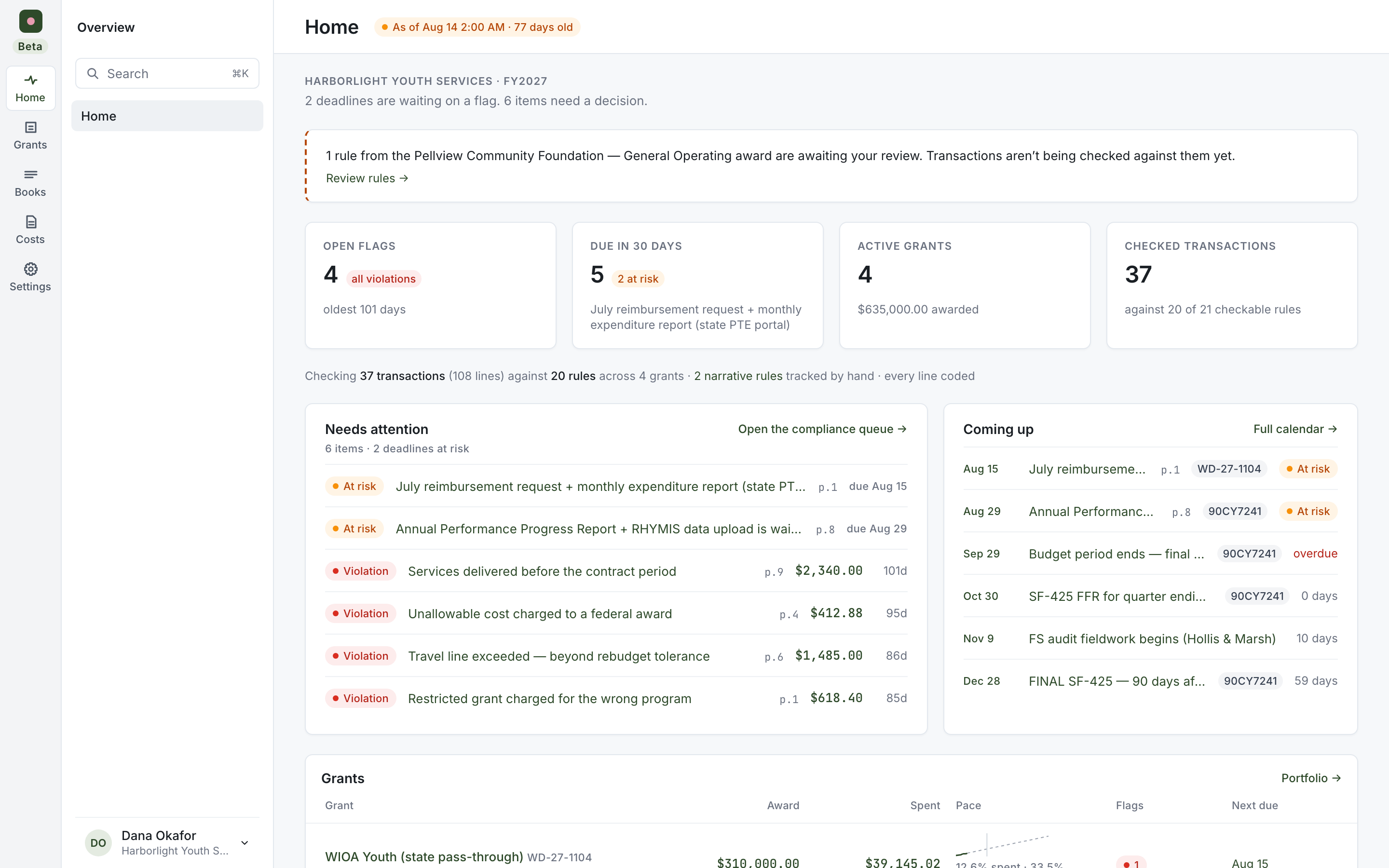
One screen answers "am I okay right now?"
Four numbers. Open flags, deadlines in the next thirty days, active grants, and how many transactions have been checked against how many rules.
Needs attention. Two deadlines are waiting on a flag. Four violations, each with its amount and its page reference.
Coming up. The next six deadlines across all four grants, on one list.
Sample data: Harborlight Youth Services, as of Aug 14.
Grant portfolio
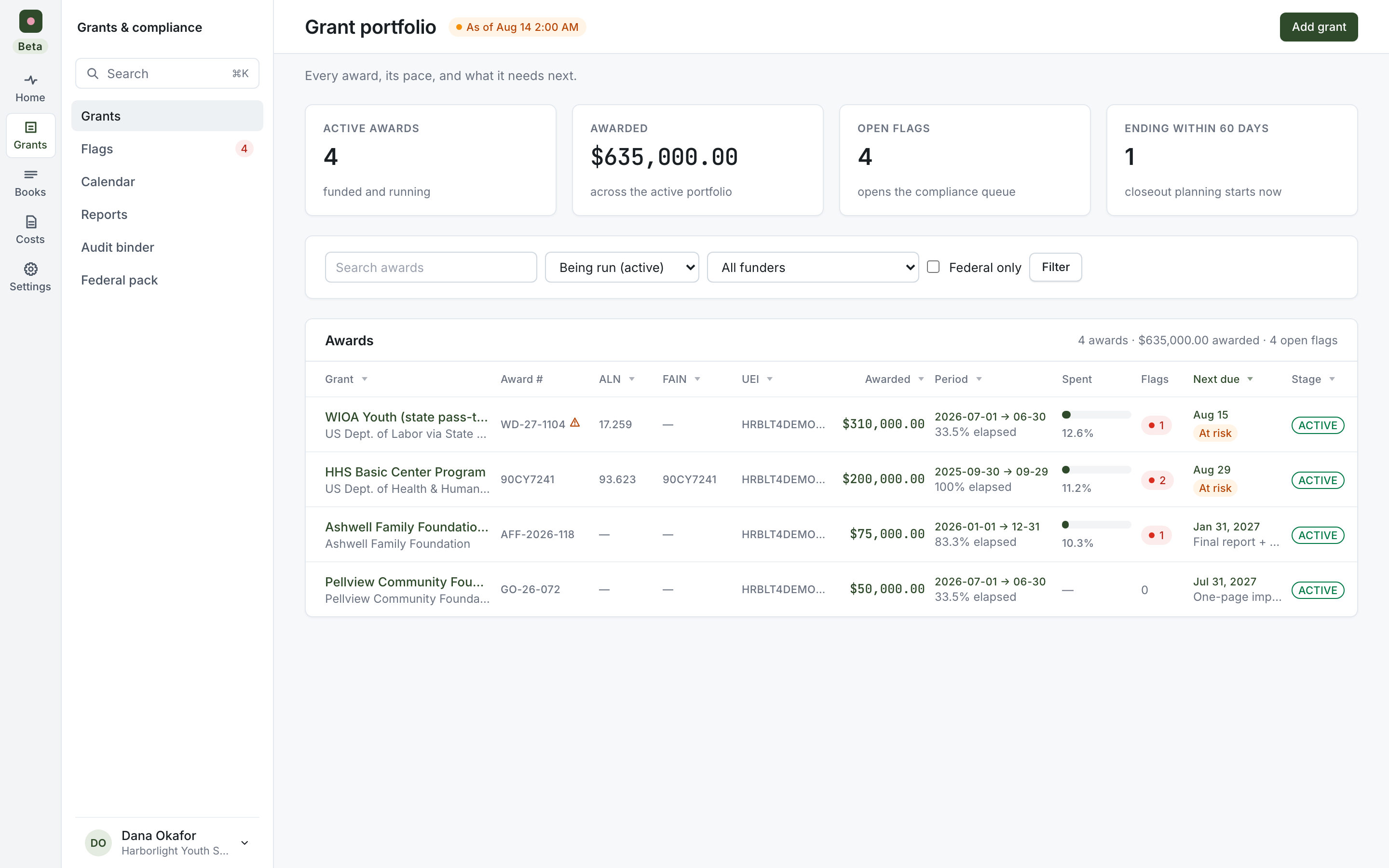
Every award, its pace, and what it needs next.
Four grants, $635,000. Two federal pass-throughs, two foundations. Each with its award number and period.
Spent against time elapsed. The Basic Center grant is 100% through its period and 11% spent. That is the conversation to have before the funder has it.
Flags and next due sit on the same row, so the portfolio is also a to-do list.
Sample data: Harborlight Youth Services.
Transactions
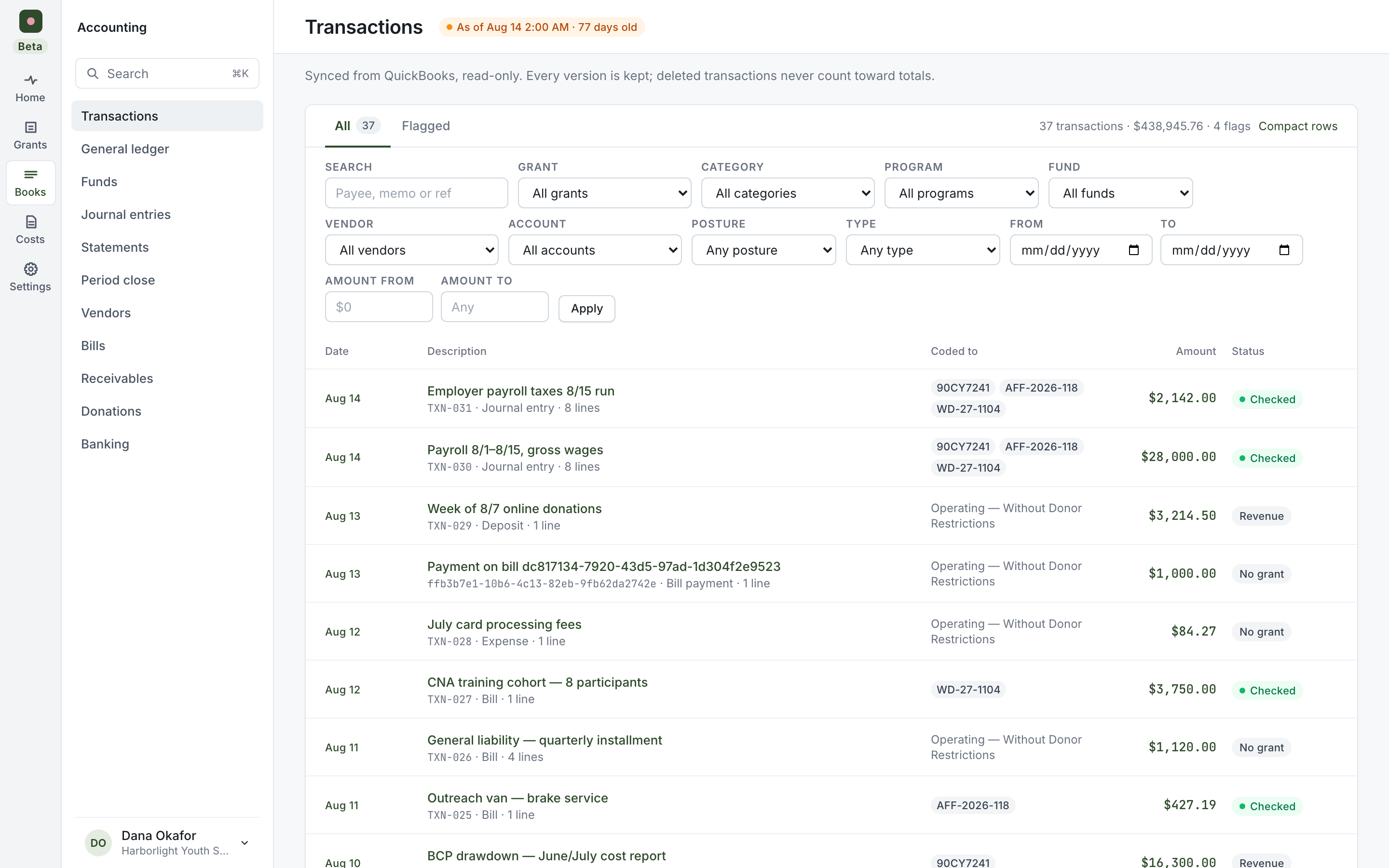
The money, as it sits in QuickBooks, with its compliance posture beside it.
Read-only, every version kept. Deleted transactions never count toward totals, so a report you filed last quarter still ties out.
Coded to a grant, checked or not. A payroll run split across three awards shows all three. Anything with no grant says so plainly.
Sample data: Harborlight Youth Services.
The flag queue
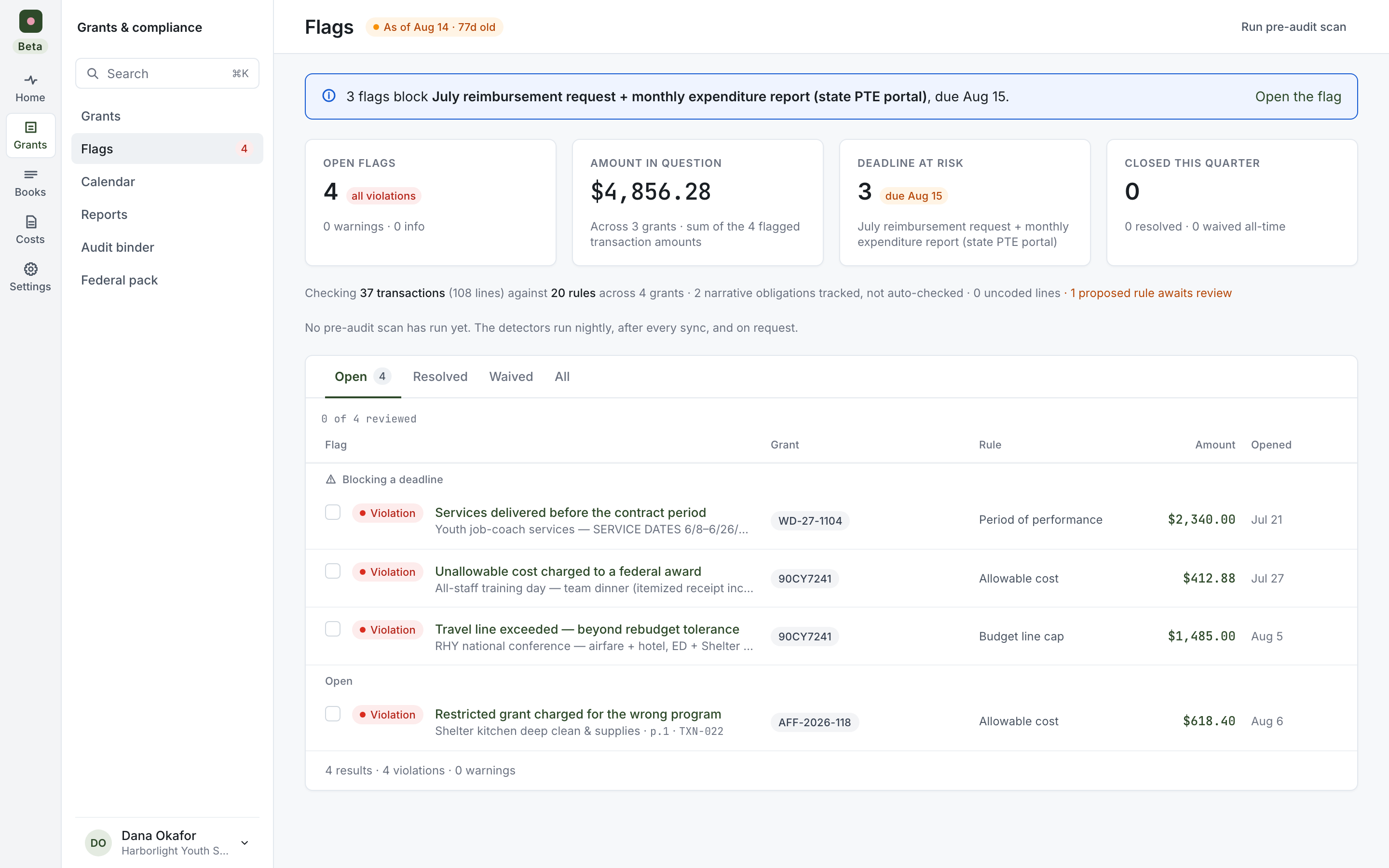
Every flag names the amount, the grant and the rule.
$4,856.28 in question across three grants, so the stakes are known before a single flag is opened.
Services dated before the contract period. The rule is cited. Dana reads the clause, decides, and the decision is recorded with her name and the date.
Resolve or waive, with a note. Either way the auditor later sees what was decided and why.
Sample data: Harborlight Youth Services.
Reporting calendar
Every report, deliverable and filing, on one calendar.
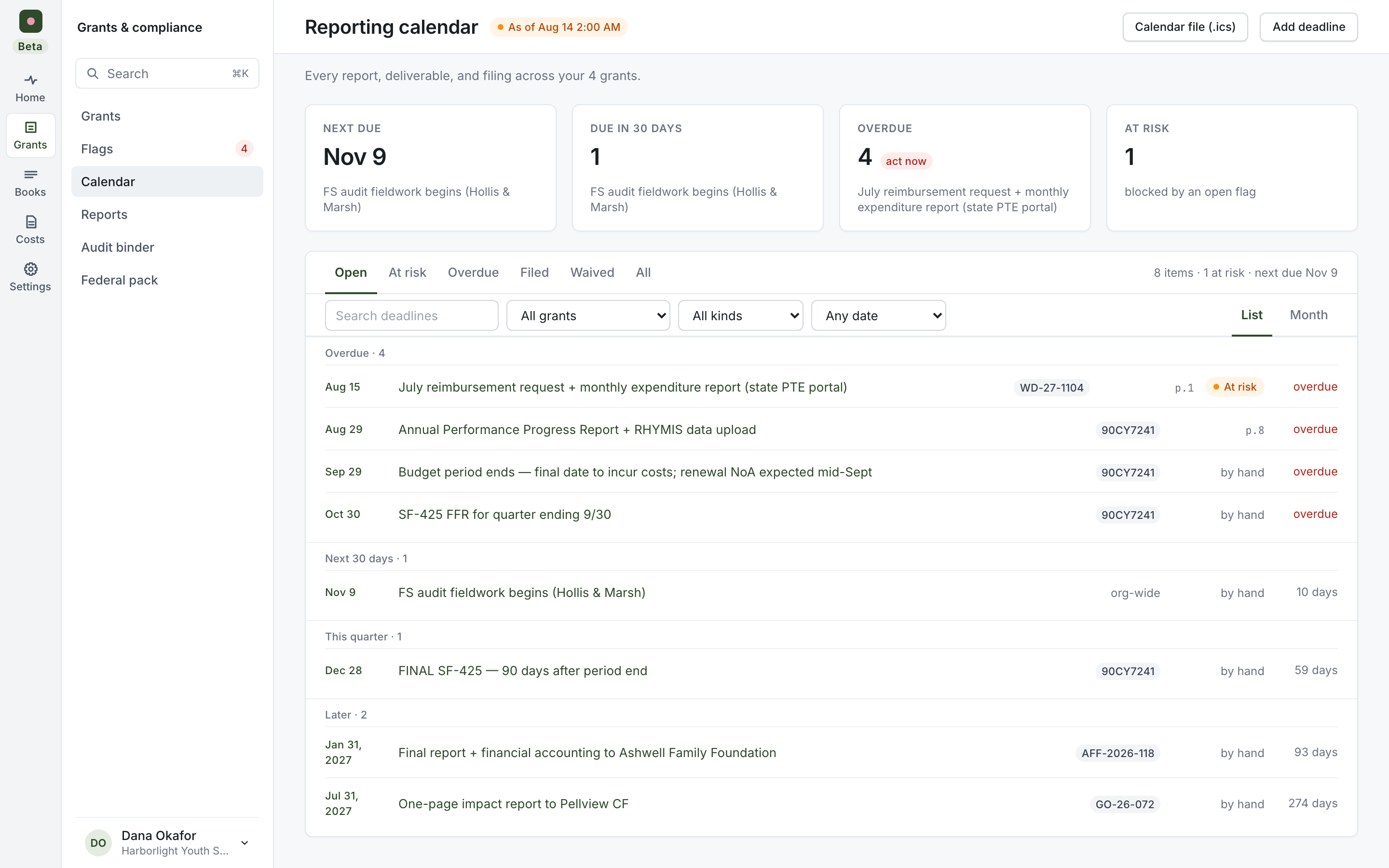
Reporting is the number one audit failure category. This page exists because of that fact.
Overdue, at risk, next due. A deadline blocked by an open flag says so, and links to the flag.
Export to any calendar as an .ics file, so the dates live where Dana already looks.
Sample data: Harborlight Youth Services.
Funder reports
The report each funder wants, in their format, from the real numbers.
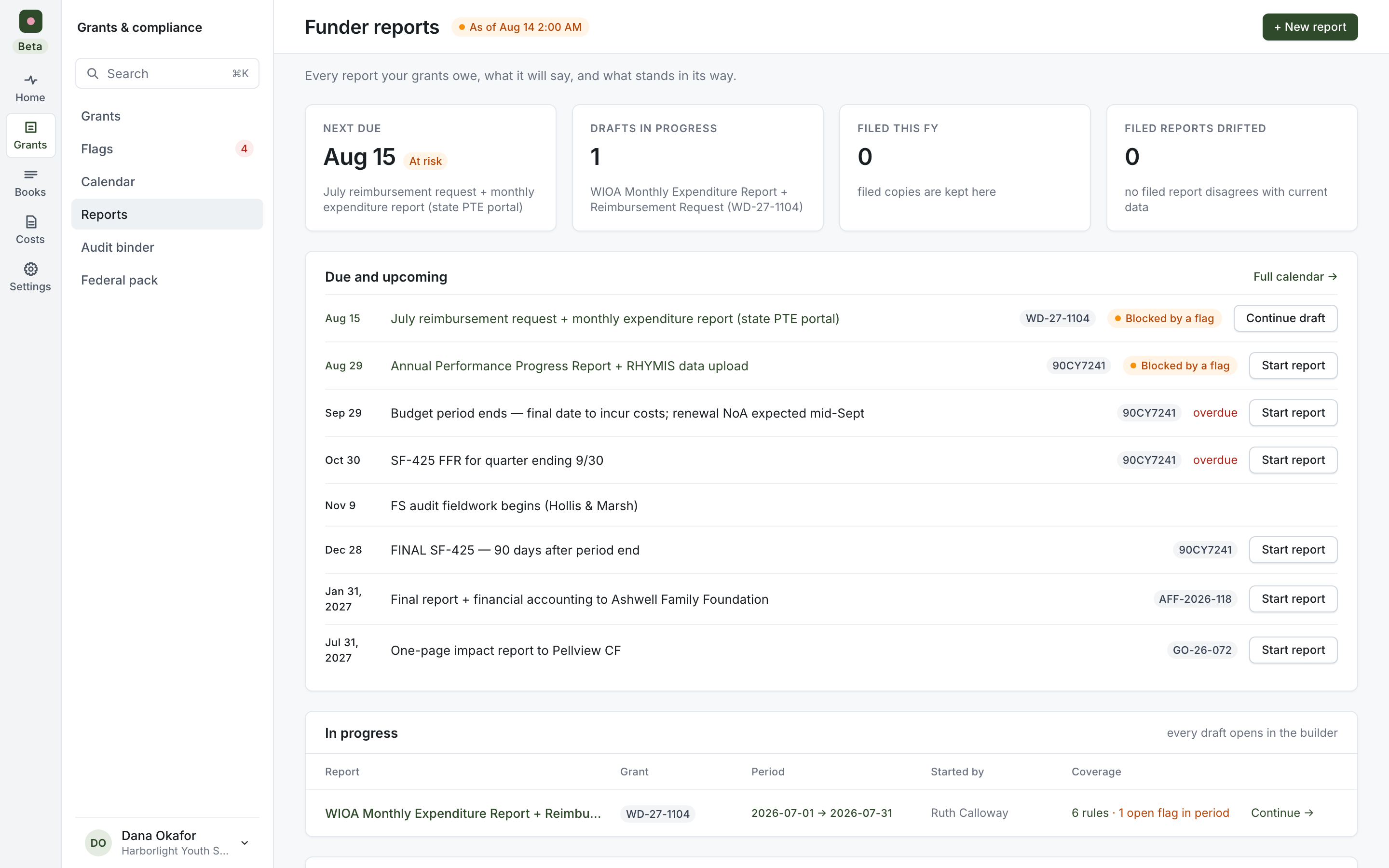
Blocked by a flag. A report cannot be finalized while a transaction inside its period is in question. That is the point.
Drafts show their coverage. Six rules checked, one open flag in the period, started by Ruth. Filed copies are kept, and the page says whether a filed report has drifted from current data.
Sample data: Harborlight Youth Services.
Audit binder
The binder files itself every night. Audit week becomes just a week.
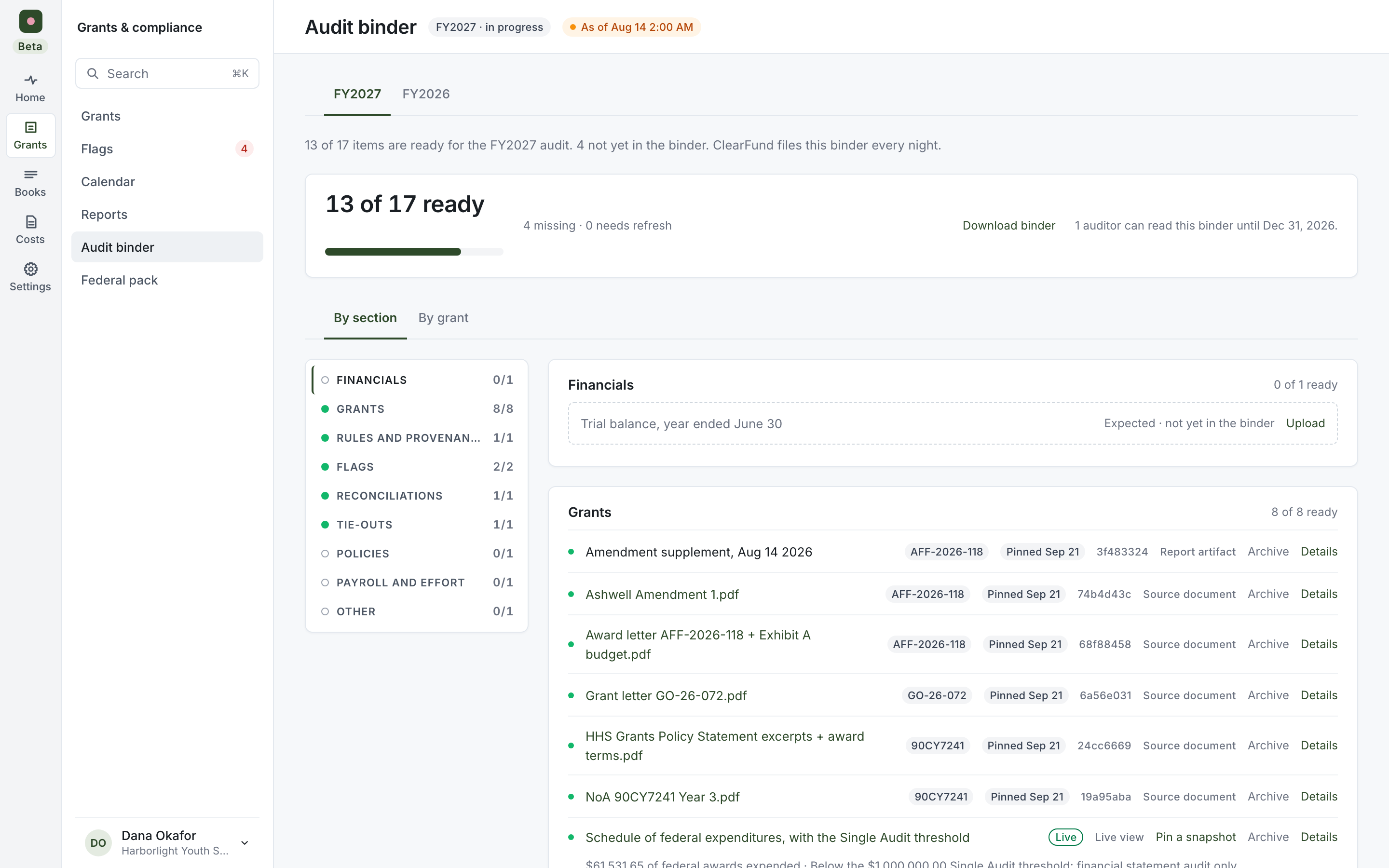
13 of 17 ready. Every document, rule, flag decision, reconciliation and tie-out an auditor will ask for, with what is missing named.
Organized the way auditors work. By section, or by grant. Each item pinned to a date, with a hash, so nobody can quietly change it later.
The auditor reads it directly. A seat that expires on a date, and every page she opens is logged.
Sample data: Harborlight Youth Services. In eleven years of competitor release notes, no vendor shipped a Single Audit binder.
Recode workbench
When a flag is right, the fix goes back to QuickBooks with a trail.
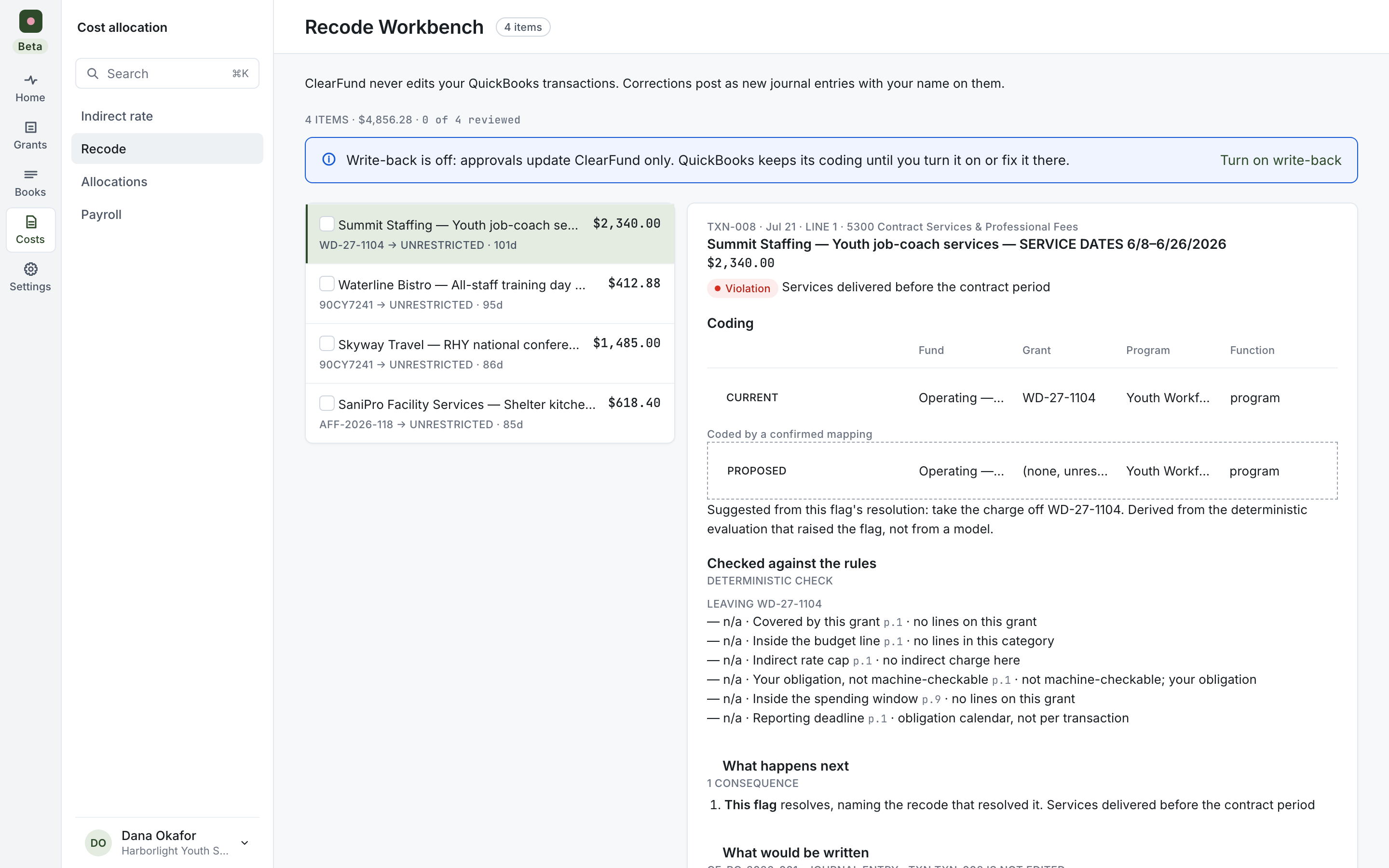
Propose, then approve. One person proposes a new coding; a different person approves it. The product refuses to let the same person do both.
Ten seconds to undo, then the change is written back and the original is kept as history, never overwritten.
Sample data. Write-back to QuickBooks is built and tested against a sandbox, not yet against a live customer file.
Costs: allocations, indirect rate, payroll effort
The arithmetic that puts shared costs on the right grant.
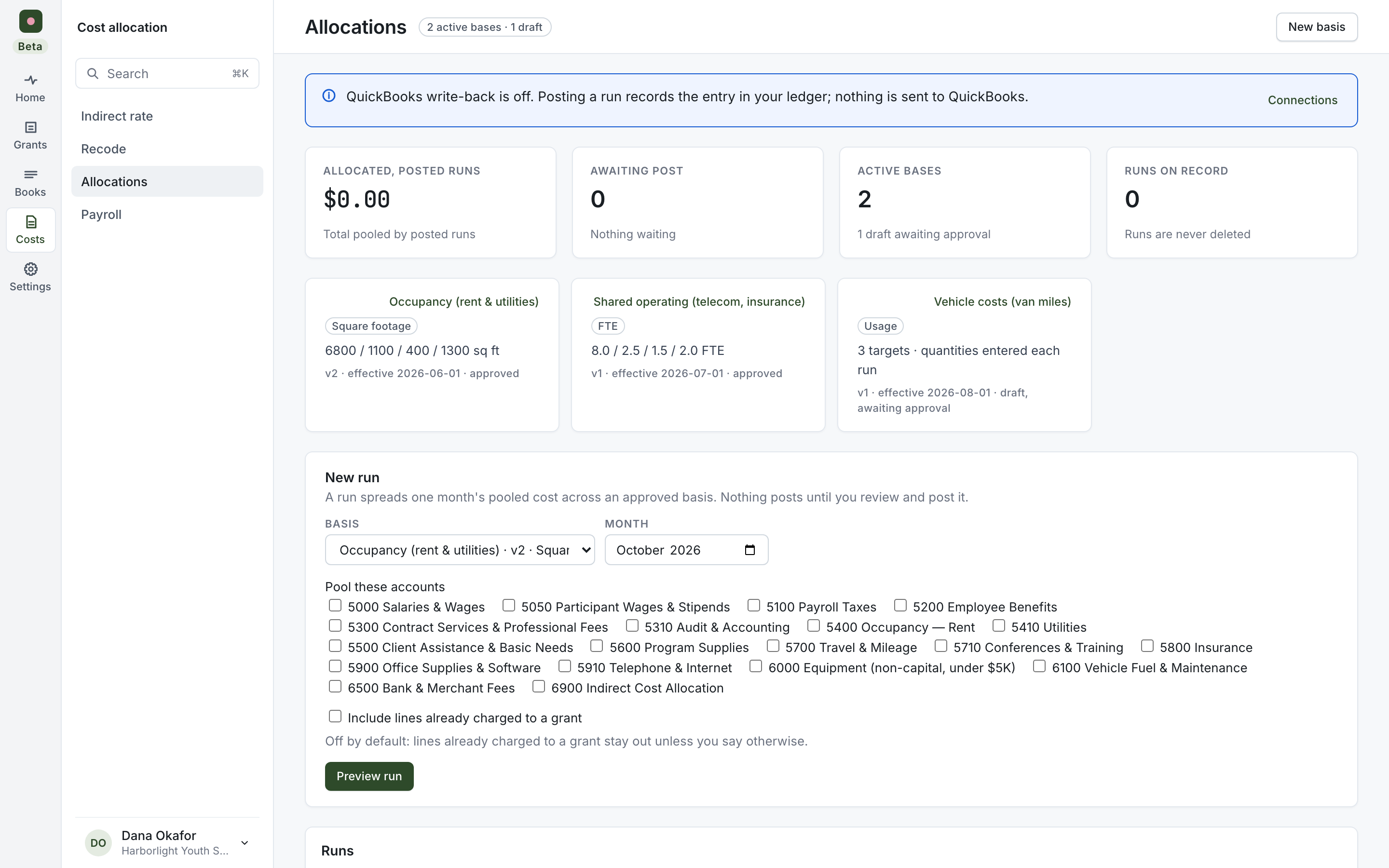
Allocations. Rent and utilities split across programs by a method the organization approves, versioned, with the run kept.
Indirect cost rate. The negotiated or de minimis rate applied each month, with the base shown per grant.
Payroll and effort. Staff time charged to federal awards needs certification. This is the finding Harborlight got twice. The machinery is built; the payroll connector is not.
Allocations shown. Indirect rate and payroll pages follow the same pattern.
Books: ledger, funds, journals, statements
A full fund-accounting ledger underneath, for the day QuickBooks is not enough.
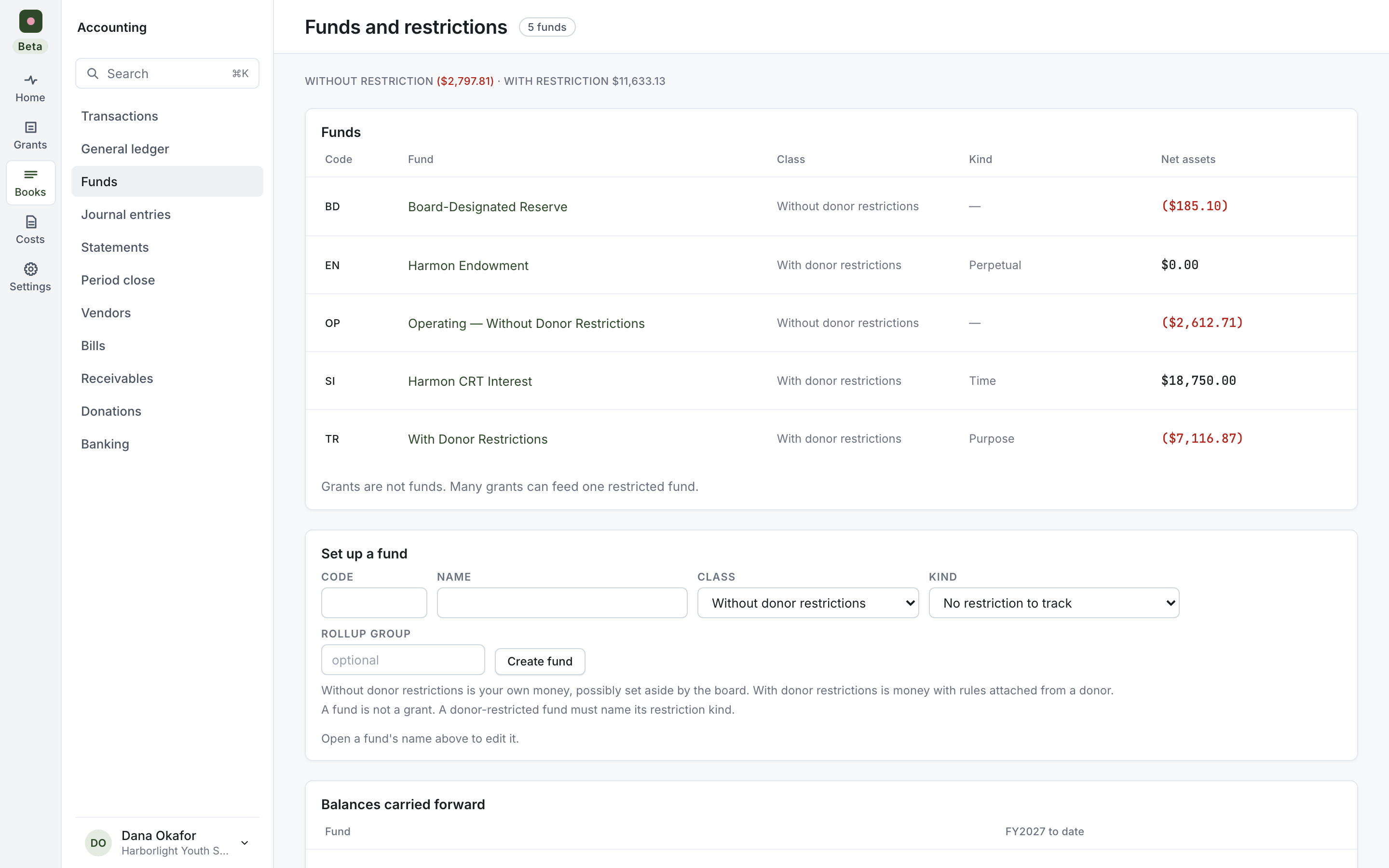
Funds and restrictions tracked by purpose and time, with releases recorded when a restriction is satisfied.
Journal entries that require a second approval, and a period close that locks the month.
Financial statements by net asset class, the format a nonprofit board and auditor expect. This is the newest layer and the least finished.
Funds page shown. General ledger, journals, period close and statements are separate pages in the same section.
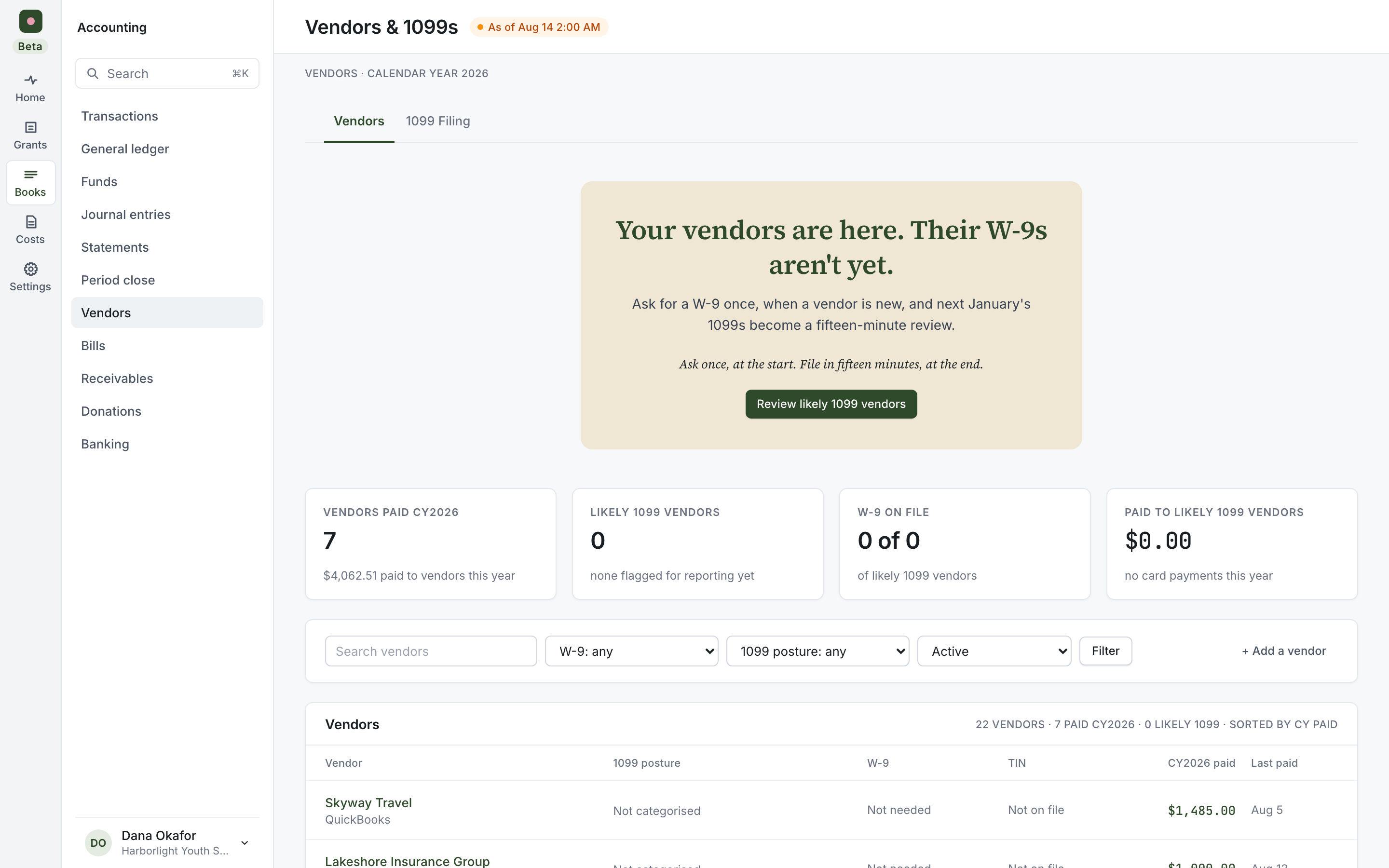
Bills and vendors with 1099 tracking, so the January filing is not a scramble.
Receivables and donations, including grant drawdowns and pledges with restriction coding at the point of entry.
Banking and budgets. Statement import and reconciliation; budget versus actual by grant and by month.
Vendors page shown. Several of these pages have working engines whose forms were finished only this week.
Federal pack and activity log
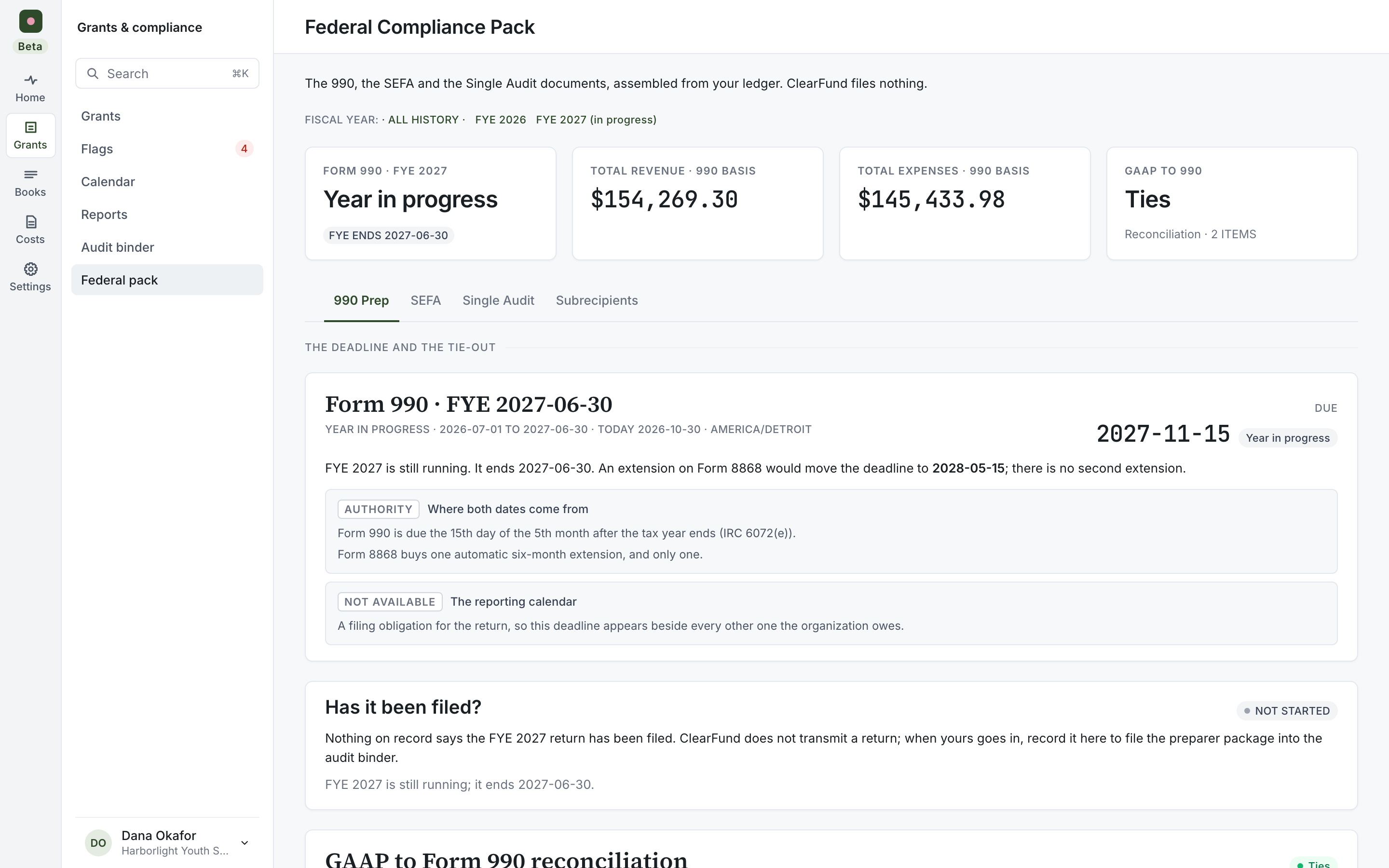
The 990, the schedule of federal expenditures, and who did what.
Federal pack. The 990 preparation view and the SEFA that decides whether a Single Audit is required at all.
Activity and audit log. Every action, by whom, when. Including every page the auditor opened.
Sample data: Harborlight Youth Services.
What is built, what is not, and what has never been tested against the world.
Built
160 of 194 planned pieces are done. The hard, boring, audit-critical half is real.
Append-only, enforced in the database
Nothing can be edited or deleted after the fact, and the database itself refuses, not just the app.
The audit binder
Frozen artifacts that hash identically every time. Proven by test, not asserted.
Rules engine, calendar, reports, flags
Deterministic checking, obligation tracking, the queue, the recode trail with separation of duties.
Ledger, allocations, payroll effort
Six thousand lines of effort-certification machinery alone. Most of it waiting on a connector.
Not built, or not proven
Three gaps matter more than the other thirty-one.
01
The intake screen
Uploading an agreement and confirming its rules one at a time is the core idea, and that screen is still pending. The extraction behind it has been measured once on real documents and was weak.
02
A real QuickBooks file
The sync is built and tested against sandbox data. It has never pulled one real customer's books, because no customer has connected one.
03
A real auditor
The binder's whole thesis is that a CPA will trust it. No CPA has seen it. That gate is open and waits on one meeting.
The honest number
1,984 commits. One message sent. Zero conversations with a customer.
Everything in this deck was built from public audit records, competitor history and careful reasoning. None of it has been checked against a person who does this job. That is the gap, and it is the next thing to fix.
What the data cannot support
An outside review found several of our own market numbers were miscounted, including the claim that executive directors, not finance staff, are the buyer. The split is about even.
What survived the review
The incumbent weakness is real. Nobody has shipped a Single Audit binder in eleven years. The code quality is high and the repo does not lie to itself.
Three studies, and the one thing none of them could tell us.
What the research found
Where incumbents are weak, where the pain is, and who to talk to.
1,259 competitor changes, 2015 to 2026
Blackbaud, MIP and Sage Intacct. Grants got 23 of them. Accounts payable got 387. Single Audit, SEFA and Uniform Guidance appear zero times.
31,040 nonprofits, ten years of audits
Who failed, how, and how often. Reporting and allowable costs lead. The trigger is rare: a given organization is cited roughly once in three years.
84 channels to reach this person, 83 verified live
Not conferences, not ads, not Reddit. A finance forum where they already ask, one-to-one email to people with a public finding, and the bookkeepers who serve dozens of them.
The one thing research cannot provide is a conversation. Everything from here is about getting eight of them in fourteen days.
Stop building blind. Start with the people.
The next fourteen days
Find out whether anyone wants this, before building another screen.
01
A landing page that gives before it asks
Look up your own nonprofit's ten-year audit history, free, from the public record. Then one question: what did your last audit cost you?
02
Ten hand-written emails a day
To people whose public finding we can name, asking for twenty minutes about their last close. No product pitch. A corrective-action-plan template as the gift.
03
A monthly roundtable, not a Slack
Six to ten finance people, one hour, no product. The platform comes later, if twenty people show up twice.
Success in fourteen days looks like eight conversations, four people volunteering to show a spreadsheet, and the same pain named unprompted by more than half of them.
ClearFund
The right dollar, the right grant, every time.
That is the promise. The next step is finding out, from the people who keep these books, whether it is the promise they need.